12 July 2015

Tyrolean week

A couple of weeks ago I would have word-associated “Tyrol” with Austria, sausages, lederhosen, flower-drenched chalets, folk dancing and brass bands. And “Dolomites” would have conjured stark, monolithic limestone cliffs and high-level refuges linked by precipitous via-ferrata trails. Putting the two together, and discovering that the South Tyrol is in fact in Italy, and that the Dolomites bear little resemblance to my pre-conceived image, has been a revelation. 

After driving 7 hours from Juan's CH flat (via Innsbruck) we arrived at Val di Funes – or Villnösstal, 45 minutes NE of Bolzano, almost as far north in Italy as you can go. A light goes on and I begin to understand my Googling confusion: Val di Funes and Villnösstal are the Italian/German versions of the same place. Even Juan – better historically educated than me – is surprised that the language and culture of this corner of Italy is quite so evidently Germanic. How come? (Skip next four paragraphs if history isn’t your bag.)

The South Tyrol was part of the Austro-Hungarian empire until 1918. After the First World War an agreement brokered by the US gave Italy 150,000 Tyrolese German-speakers. Until the 1920s the Italian authorities didn’t interfere with Tyrolese cultural activities, traditions or schooling. But, in October 1922, the new Fascist government implemented an Italianisation program, decreeing:
  • exclusive use of Italian in the public offices
  • closure of the majority of the German schools
  • incentives for immigrants from other Italian regions.
Then, in 1939, Hitler and Mussolini gave the German-speaking population a choice: they could emigrate to neighbouring Germany or stay in Italy and accept complete Italianisation. After the War the Allies decided that the province should remain a part of Italy, with German and Italian both made official languages, and German-language education permitted.

After a large of argy bargy, cut to… a new agreement signed in 1969. Since 1972 the Tyrol has had a considerable level of self-government and is the wealthiest Italian province. It has strong relations with the Austrian state of Tyrol, especially since Austria's 1995 entry into the European Union, which has led to a common currency and a de facto disappearance of the borders.

In a nutshell: the German-speaking population is in the majority and it feels as though you’re in Germany. For the entire week I think I heard Italian spoken just once. This was all very good news for Juan, who lurves the language. (And bad news for Rebecca, who doesn't speak a word...)

As we drove up Villnöss valley the peaks of the Geisler range gradually emerged above the emerald pastures, and forest. Many of the vast farmhouses have been converted into tourist accommodation. But agriculture is still very present, and haymaking – largely unmechanised on the steep meadows – was in full swing. At our destination, “Putzerhof”, the air was perfumed with the sweet smell of drying, flower-rich grass. We were welcomed by our hosts, Herbert Fischnaller and family (settled at that site since 1258). 

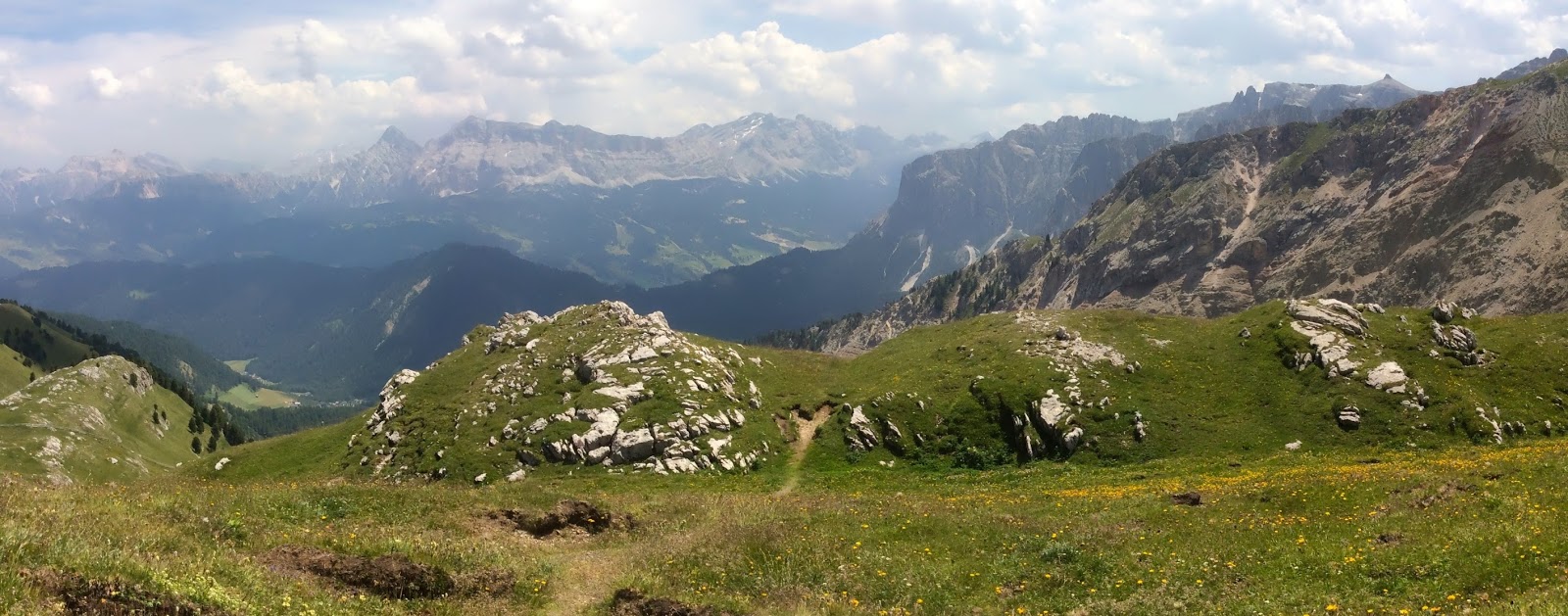
The stunning view from our flat faithfully replicated the website images. We enjoyed it in all weathers, the rock colours changing according to temperature and time of day. The flat was to prove an ideal location for exploring the ridges and valleys of the Puez-Odle Nature Park.


The UNESCO status conferred on the Dolomites in 2009 has strengthened the conservation movement. It seems unlikely that the desire by some in the community, to open up the area to skiing, will have a future. And how refreshing that is – coming from the French Alps – to see no ski infrastructure whatsoever: no ugly seventies blocks of flats or ski lifts, none of the associated scarring of the landscape. There isn’t even a campsite. The view across the valley from our eagle’s eyrie can’t have changed in centuries.

The Dolomites… are not, as I had assumed, a single coherent massif. But nine mountain systems spread across five Italian provinces, comprising part of a national park and several regional and provincial nature parks. “Dolomite” is a dense, white-to light-yellowish rock that takes its name from the French naturalist Deodatus de Dolomieu. In 1789 he was the first to describe the chemical composition of the rock. In 1864 the name was coined by English writers in a travel book entitled The Dolomite Mountains.

The variety of spectacular vertical forms (pinnacles, spires and towers), and contrasting horizontal ledges and plateaus; the constantly changing rock colours; and the completely bare mountain crags rising abruptly from the gentle contours of the meadows have lead to claims that the Dolomites are “universally considered the most beautiful mountains on Earth”. I could quote at length our tourist literature on the early travellers, the romantics, and notions of the sublime. (And at even greater length about the geology – how hundreds of millions of years ago the Dolomites were islands in a tropical sea.) But the short story is: accessibility. You can gaze at the jagged, other-worldly rock faces from the comfort of your own balcony, “reassured” by familiar agricultural scenes. There is no arguing: the Dolomites are drop-dead gorgeous. And – unlike our French Alpine stamping ground – you don’t need to make much of an effort to get to the most idyllic spots. 

The result? The paths were not as crowded as you might expect, because the network is extensive and walkers were well spread out. So on some days it was possible to be alone for several hours without encountering another person. Within range of the car parks was another matter: hoards of (mostly elderly) trekkers would typically walk a kilometre or two to a mountain hut and enjoy a hearty lunch of cured ham, cheese, dumplings, and apple strudel.

So here’s a summary of our week in the South Tyrol (most photos © Juan as I’m a cable short of being able to get them off my camera, but can claim © photo-editing!):

St Magdalena and St Johann church 
an idyllic route through traditional hamlets to St Magdalena and St Johann, probably the most-photographed scene in the Dolomites: 


from Russis Kreuz along the flank of the Aferer Geisler range to Würzjoch
From Würzjoch we hitched back to our starting point:


circuit from Zanseralm
via the Gampen Alm and Schlüterhütte/Genova refuges and down via Medalgesalm:



Bolzano – beautiful, but impossibly hot
It was thrilling to see Ötzi, the 5000-year-old mummy, displayed in the archaeological museum. Curious to view the video of him being retrieved in 1991, hauled amateurishly onto a stretcher. The text explained in the politest possible terms how forensic scientists had been thwarted from gaining a full interpretation of events by those who got there first:


wet-day walk from Puzerhof to Munt Weisen
and lunch at Herbert's little restaurant:


Mt Tullen
I didn’t make it to the top – handicapped by my footwear (sandals helped me cope with damaged toes but they have their limits…):


around Der Peitlerkofel
a popular route with constantly changing panoramic views:


On our last day we drove back to Switzerland through a smorgasbord of scenic areas, starting with the wine-growing areas on the border, then through charismatic Glurns, an unexpected bonus...


Then up hill and down dale for the rest of the day… finishing with a tour of big-name CH ski resorts and back south of Zurich and Lucerne, foot firmly on the pedal. Switzerland is a bigger country than I realised – over 5 hours from the Italian border to Yverdon. Phew.

It’s time to stop and find a lake. I’ve been way too long on the computer today.


17 June 2015

in my grandmother's footsteps

I have been travelling again. Down obscure self-development paths, and more conventional tourist routes in the Bouches-du-Rhône département, of which Aix-en-Provence and Marseille are the best known cities.

In addition to attending an introductory craniosacral therapy weekend organised by the shiatsu school near Aix that I'd been wanting to discover for a while, I had been hoping to pick up the trail blazed by my maternal grandmother, AKA grannie. A photo album of the trip she made with two friends, in the winter of 1935, recently surfaced at my parents'.

grannie's vist to Cavalaire-sur-Mer
For a month the trio visited the coast between Marseille and Fréjus, car-touring and painting – or at least that's what "the artists" in grannie's captions did. And how did my mother cope with her ma jaunting off for so long, at the tender age of eight? And my grandfather – who had to make the drive from England, to rescue one of the friends who fell ill mid trip.

Back to self development, and the "yoga of the vagina" workshop. What can I say without freaking you out... Probably nothing, but I'm going to press on. Skip the next three paragraphs if this is already more than you want to know!

So there we were: nine brave souls willing to (discretely) explore our most intimate body part. In a group. But in fact being in a group wasn't the problem; we were lying horizontal, well covered with skirts and throws. All self exploration was out of view. Almost. (The fact that it wasn't quite, was exceedingly disturbing for a brief period!) The difficulty was more to do with the jade egg. Check out jadeeggs.com. According to multi-orgasmic.com (yes, you read about it on Rebecca's blog), the use of the egg evolved in ancient China. So we have a long history of disassociating ourselves with this potential source of power... And, by the way, it's not just about improving sexual function; using the egg on a regular basis can help with all manner of gynae issues. So go for it, girls...!

But, alas, I didn't make friends with my (obsidian) egg, and ended up at the familiar psychological wall. Plenty of time to try again, in the comfort of my own home, however...

The next day I hit the road, using the car-sharing website, blabla.fr for the first time. And it worked a treat. So if you can commit to a departure time, and have space in your car, why not take an extra passenger? It's sociable, ecological, economical, and makes sense in every way.

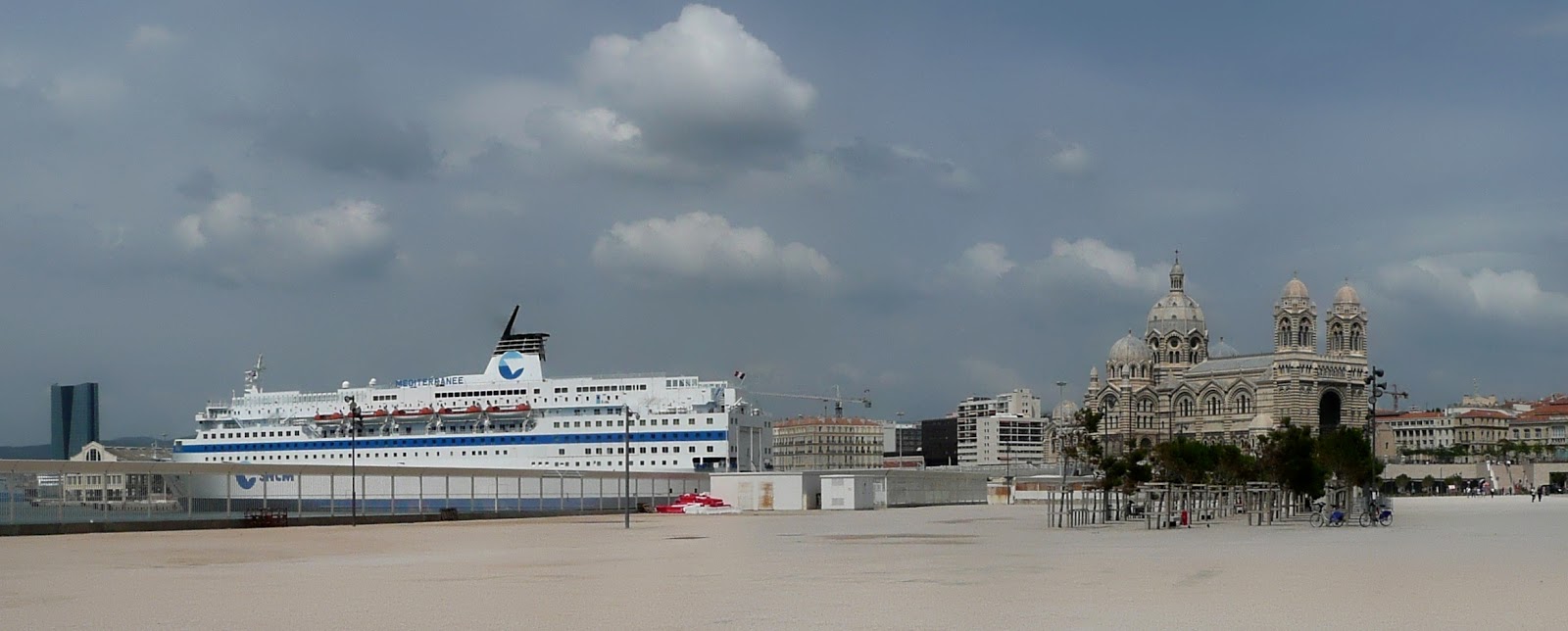
I was dressed for the 30 degree forecast, so the squalls and 14 degrees driving south were a surprise. But the afternoon shaped up, and I was able to enjoy a rapid skim over the newly refurbished old port area in Marseille in warmth, as the storm clouds gathered.


The tourist veneer – an imaginative blend of restoration and elegant new museums, linked by high-level walkways and with pockets of garrigue-style planting – was impressive, the ambiance reminiscent of Bilbao, Liverpool, Newcastle... which have received similar make-overs. Of course, there's an inauthenticity around "sanitising" big bad Marseille in this way. But you don't have to go far – just a block – to get the feeling of the real city: narrow streets, washing hanging to dry from flats in an uncertain state of repair.


Everything was going well. I was about to drive back to Trets, the little town just east of Aix where I was overnighting with an ex-student at the Aix shiatsu school, when suddenly, my wallet wasn't where I expected it to be. My handbag and rucksack are scoundrels for hiding things, with their myriad pockets. But I searched everywhere. Nothing. I jogged back to the shop where I'd bought some wine for my host, in a lather of sweat, just in case... Nothing. OMG. How am I going to get the car out of the car park? Let alone navigate the weekend cashless, chequeless and cardless. It's so obvious – Marseille – what do you expect... Trying to avoid panicking I phoned my host to ask her to cancel the cards, which she efficiently did. And then I found the wallet, in an unlikely pocket in my rucksack.

At the car park, stress seemed to have blown a fuse in my brain: I had no idea where I'd parked (yeah, I know, where had all that mindfulness gone?!). Running in ever-diminishing circles I couldn't even locate the reception office reputed to record an image of the number plate of every vehicle entering the car park. Half an hour later I spot the Megane. Oh joy. But oh no. The payment machine doesn't accept cash. Now I really do have to find the reception desk. And, by now, my parking fee has escalated to 10 euros. Dam. But I'm out. And grinding into the Marseille rush hour in the mother and father of a storm. I don't think I've ever driven in such conditions. As the monsoon descended, cavalier drivers cut in from right and left, throwing up tidal waves of water that completely block all visibility for seconds at a time. Utterly terrifying.

I arrived at Annick's, joining her and her husband Jean Paul late, but they had waited for me and we had an enjoyable supper. Being based there worked well for the weekend. I was superbly looked after.

But the course assured my stress levels were maintained. The craniosacral therapist, David Kanner, was a patient, intuitive teacher. But he didn't hide the fact that trying to bring something meaningful from a four-year training into two days was a challenge for him, too. The combination of extreme subtlety – feeling the movement of the different skull bones, dense theory (with no physical skeleton to demo on, no 3D software), and everything of course being in French, guaranteed that I had a difficult time. This is the first shiatsu-related training I have done in France and there were many cultural differences, both in terms of shiatsu style, and traits of nationality: passivity in receiving, bossiness, and a tendency towards Il faut... (and yes, I know all about projection!). I was close to ducking right out of the second day. But decided against, following David's advice. So I stuck it out, finally clutching to a handful of simple techniques that I might be able to integrate into my shiatsu.

That second evening I felt light, truly on holiday. I drove towards the Mont Sainte Victoire, the ridge peak north of Trets and east of Aix, and walked up to the hermitage on its flank. Seated there I enjoyed a pleasant contemplative moment, the late-afternoon sun lighting the vineyards and lines of hills receding south.

After the weekend I extended my trip a couple of days, taking advantage of my current lack of commitments. Beyond curiosity about much-lauded Cassis, I had no agenda. But I wanted to savour the flavour of the rolling, craggy, wild, garrigue countryside. So I took the most off-beat route I could find: using sat nav to drive minor roads, climbing and descending the west-to-east chains of hills. It's a lovely, unspoilt part of Provence, a far cry from the tourist traps of chintzy St Remy (virtually my only other experience of the region); cyclists more in evidence than cars.

view towards the Mont Sainte Victoire
The same cannot be said of Cassis – obvious at the first "car park + shuttle bus" sign. It's undoubtedly a place of great charm, full of delights – if classy shopping is your bag. But retail is not my therapy so I headed for the jetty and jumped on the first boat trip to the Calanques, the fiords and inlets that are the major tourist draw. This is arguably the best way to get a perspective on this beautiful and relatively inaccessible area. Having one's own boat would be even better!


From the boat we could see the quays used until the twentieth century for exporting the cement and limestone used to build the Mediterranean ports of Alexandria, Algiers and Marseille, as well as the Statue of Liberty. More recently, tourism and wine making have taken over. Cassis was one of the first three vineyards to profit from the appellation d'origine contrôlée introduced in 1936.

Still avoiding the town itself I strolled around the top of the first calanque for a different view...


Actually getting into the sea was bizarrely difficult – if you wanted to avoid the mega crowds on the shingly town-centre beach. But I found a place where the limestone slabs tilted towards the sea, allowing a way in. Perched above the sea, along with a bunch of tourists and locals, I nerved myself to jump in. The water was delicious, but the sucking and propelling of the waves alarming. And getting out was every bit as difficult as I had anticipated. After a few abortive attempts I allowed the waves to whoosh me up onto the ledge, from where I could make an ungainly exit, walrus-style. A local asked me if I was ok, and commented on the danger – he had hurt himself getting out.

From Cassis I drove along the spectacular Route des Crêtes, Cap Canaille giving vertiginous views over the bay.


... to La Ciotat, a real fishing port with a picturesque, oleander-bordered harbour and active dockland area.


Having been eating a rice salad made in Vaulnaveys for the previous three days I decided to treat myself to a restaurant meal (bad choice – an absurdly over-priced, over-cooked stir-fry) before driving east along the coast, looking for a possible camping spot. I am naive, having no idea how grim coastal camp sites in the populous Cote d'Azur can be. I couldn't see myself spending the night in any of them. The sun was going down and I was running out of time...


Hastily snapping the shot above I continued to a car park in a forest near a beach near Port d'Alon. Carefully driving to its furthest extremity I waited for night to descend before unrolling my sleeping bag and bedding down next to the car. For a while I feared being discovered as the headlights of the last visitors left the area. And then a vehicle seemed to be passing right next to me, entering an adjacent property. But all quietened down and I was left with just whining mosquitoes for company.

It wasn't a great night, I admit. But I was happy to have made my choice – and survived it! At 5am I was off and out, sadly renouncing the early-morning swim that had been the reason for being there, but intimidated by the presence of a vehicle that had appeared during the night, and the possibility of law and order catching up with me (it would be hard to pretend "no overnight parking" was ambiguous).

Back at La Ciotat I used the facilities of one of the camp sites I'd rejected the previous day, then spent the morning tanking up on coffee, and blogging, in a quayside café. Pure happiness. Then, just as I thought I was going to leave La Ciotat – which, you will gather from the large number of photos posted above, was the highlight of my trip – I tumbled on a little bit of paradise: Plage du Mugel. And there I spent the next couple of hours, swimming in its glorious, crystal-clear water and watching the primary-school geography lesson taking place nearby, grandparents playing with their water-pistol-toting toddlers, girlies taking snaps. Now I understand why everyone goes to the coast for their holidays. This was truly heaven.


But all good things had to come to an end. It was time to leave. I wanted to make the most of my trip by camping somewhere between the coast and Vaulnaveys. So I took a sinuous, non-motorway route via Manosque to Sisteron. Here I found myself once again turning my nose up at the camp-site possibilities. After extensive touring I found an acceptable spot between a cornfield and a stream.


I was about to snuggle into my sleeping bag when I had a moment of panic: what was I doing the following morning? Oh the limitations of a digital diary. I was out of charge, so no way of finding out… I looked at my camping spot and made a quick decision. Home it had to be. And, probably for the best – rain later fell in copious quantities.

So now I am home, having not made it to Cavalaire-sur-Mer, but grannie very much in my thoughts as I wove around the many other wonderful places.

06 June 2015

Buff and Poppy come to Vaulnaveys-le-Bas

In contrast to the heavy-duty words in my last post here's a visual record of Buff and Poppy's short and sweet visit, last week. There were tears (Buff wasn't happy about the flying fox at Laffrey air park) but overall it was a lovely, happy couple of days...

Piling on the winter clothes for the first (chilly) evening, toughing it out on the terrace

We all got very over-excited playing “Timba!”

Lac Laffrey in balmy sun – but not hot enough to swim

Buff made sure we didn’t get into the mountains – by only bringing sandals. But I got her to walk half a kilometre – to a restaurant.

My favourite local restaurant, La Basse Cour, by Lac Laffrey

Laffrey air park, last visited with Olly and Poppy in 2008 and some of us showed our age -
while blithe 4-year-olds put us to shame...

The final flying fox was a bridge too far for Buff, but definitely to do again for me


My ancient Monopoly board got an airing and Poppy revealed new talents, beating Buff and me, hands down


enlightened?

This week I completed the 8-week MBSR (Mindfulness Based Stress Reduction) course. All is Zen. I am floating on a cloud of detachment… Ha ha. Zen cloud? Pull the other one…

But the following (which I’m writing here to set an intention as much as to mark an end point) is true. The irony is that all this mindfulness and meditation stuff has the ultimate effect of quietening brain activity and getting one into one's body and senses – which some of us have lost contact with. But writing about it uses words and concepts, and I've been accused of intellectualising. Tant pis. It's the best I can do.

  • I am a teeny weeny bit more aware of thoughts coming and going. In the same way that sounds come and go, no beginning or end. Sometimes the image of waves breaking on the beach works for me. A continuum. 
  • Noticing thoughts is the first step towards deciding what to do with them. Sometimes I can choose whether to identify with a thought, i.e. whether to let it take over and have power over me.  Or I can notice when a thought is unhelpful, and do my best to let it go, because it doesn’t truly exist. 
  • The flip side of this is that (on a good day) I can choose to amplify the thoughts that give me a sense of well-being, making that feeling last just a bit longer. It could be a random moment of happiness – the sound of bird song, light on a leaf or simply asking myself how I feel – and realizing that I’m happy for no particular reason. Bringing full awareness to the good moments in life, and being curious about detail, are necessary antidotes to our predominantly negatively wired psyches (an outdated evolutionary device to ensure survival in a hostile world). So it’s a kind of neuronal reprogramming. And a bit of a mountain to climb, for me.
  • When all else fails I can come back to my breathing, which I can depend on. And can “surf” on its rise and fall, feeling its support.
  • When something is uncomfortable, physically or emotionally, I can use breathing with that experience to change my perception of it. It becomes a smaller part of a bigger whole. Sometimes.
  • Since I am doing this for myself, rather than (my usual strategy) going to a practitioner or therapist to sort me out, I have a sense of looking after myself, taking some degree of control, making choices. This feeling of “uprightness” starts with the way you sit to meditate, “solid as a mountain”. And “upright” is the first word I wrote on the stone we were given at the end of the session, as a way to anchor key words that would sustain our practice beyond the course.

But 8 weeks is way too short a period of time to integrate and establish a routine, especially since our teacher, Anouk, not only distilled the content of Jon Kabat-Zin’s MBSR course, but had also included aspects of cognitive-based mindfulness.

The cognitive aspect included aller vers l’aversion: allowing in a difficult thought (e.g. discomfort sustained during the meditation session or an uncomfortable feeling of any kind) and being fully conscious, breathing with it as described above. With awareness and acceptance, one’s perception of the issue can change; it becomes part of the whole, no longer the dominant thought. It’s resistance that brings and sustains pain.

Another aspect of the cognitive-based approach was encouraging us to create a cahier du bonheur. The reason for this is that research has shown that people who have been depressed are less likely to fall back into depression if they are using MBSR and a proactive approach whereby positive thoughts (mentioned above) are written down along with any positive experience that can nourish us when the chips are down. And this can work as a preventative, too. So every encouraging comment anyone makes about the Japan book, or about a shiatsu treatment – or anything whatsoever! – is now being duly recorded!

In terms of imposing a discipline I have gone digital, using an app that allows me to set timings, bell tone/frequency – you name it. (It would also give me stats on the minutes I’ve sat over a period of time. But that might invite an unhelpful performance-driven element so I’m staying with the bells for now.)

And the experiment where, for a day, I set a bell to ring every 10 minutes (as a way of being fully conscious) was interesting – and surprisingly stressful! I recommend it if you’d like to feel your life slipping away in 10-minute chunks, or if you need your computer time curbed. Ding… ding… ding…

The group, composed entirely of introverts with varying levels of anxiety or stress, never really jelled. But that was ok. Apart from the one man in the group, there precisely to press my buttons. Serge oh Serge, did we really need to know the detail of your meditation app (bingo, I’ve just done it myself), did you really need to show off your prior meditation experiences at every opportunity, take on the role of teacher – when you were several sandwiches short of a picnic in the mindfulness department… Ah well, it gave plenty of opportunity for me to sit with discomfort.

But the really sad thing was that one member of the group, a robustly positive  woman who – in a brief conversation as we left together one evening – shared her very difficult personal story, didn’t show up for the last session. And two days later we heard that she had died that very day, for reasons we don't know. I could be platitudinous but it remains a shock.

04 May 2015

how green is my garden...

Well our garden, of course, rather than mine. But, in the absence of paid work, I have been lavishing more attention on it than ever and feel a little proprietorial. The reward is intense pleasure…

April and May are usually the best gardening months here, before the heat and drought of the Grenoble summer. The foliage and contrasting colours are a joy: crimson photinia next to soft grey phlomis; the fresh, pale-green branches of dogwood beaming from either end of the flower bed; glossy hosta gleaming after rain; an exotic geranium with chocolate-brown leaves and pink flowers now well established after two years in place...


The shade bed on the north side of the house is bursting with lily of the valley, forget-me-not, geum, wood anemone, the exquisite new leaves of epimedium, ferns, peony and late daffodils...


This early in the season none of the trees are displaying the symptoms of the various maladies that will show up later in the year. The rowan is in full flower; the lime looks as though it might forgive us for the savage pruning we gave it in March, capitulating to the French way and seeking to impose a desired growth habit – which meant lopping off the central spire to force sideways, shade-producing growth in a species that was never really designed for such an adventure. Ouch, I still feel bad about that.

This week may be the last for the wildflower islands that I’ve enjoyed “sculpting” in the lawn. They are going to seed and beginning to look eccentric, rather than artistic. In the light of ongoing uncertainty about The Future I’m not investing in plants in the usual way – just doing a few containers.


But there’s still plenty of work: weed control, in particular managing the rampageous honeysuckle that now threatens to choke many of the hedge plants, is full on. 

There’s a subtle balance between that very English notion of cultivated wildness – and unadulterated jungle. I love the result: the spindles in the hedge draping themselves across their neighbours; self-seeded pansies thrusting through the gravel around the house; the hedge and honeysuckle pushing out from our property boundary, risking their lives to the blade of municipal pruning. But it’s in sharp contrast to our neighbours who recently chain-sawed down the edge of the hedge adjoining our gardens because they didn’t like it growing through the wire boundary. Alas, that was exactly what we liked! So we have lost privacy built up over ten years of hedge growth on our shared border.

Today I decided to tackle the central flower bed, where the mahonia is now monumental, but without huge interest. I was about to launch into a major curtailment of its bulk when I found myself eye to eye with a nesting blackbird. Yikes. We’d been observing its mate (?) flying to and fro over a period of several weeks but hadn’t seen them recently. Having googled and found the incubation period is only 2 weeks, we had assumed the nest had been abandoned. Not so. So the mahonia lives another day.

26 April 2015

mindful and mindless

Something strange is happening… I am feeling happy! Is it spring? - or being purposefully employed (see previous blogs)? Or the beloved garden giving so much pleasure… or enjoying Juan’s company, this weekend, in simple ways - a meal at the excellent Basse Cour restaurant, near Lac Laffrey (discovered recently with a pal); strolling the lanes around Chollonge; more joys of food chez nous (rice pudding with homemade blackcurrant coulis - seriously yummy...).

I know my weakness as a cook is presentation - I whack down meals on the table gauntlet-style, earning myself the nickname of “Viking”, as far as Juan is concerned. But the Japanese experience - and of course France - has taught me something of the value of aesthetics: delighting the eye in anticipation of the palette. So I now trickle the coulis gracefully across the pudding - even if, at a later point, greed takes over and I dunk the spoon straight into the jar. (I can refrain from that last part if ever someone books a room and a meal…)

But I think my recently positive mindset may be linked to the mindfulness-based stress reduction course I’m enrolled on. Like pretty much all of us, over the years, I’ve dabbled in meditation, breathing, yoga, qi gong and other mind-calming, spirit-centring techniques. And I have raged and ranted against the ****** impossibility of establishing a routine. Paying money and committing to showing up for 8 weekly two-hour sessions has been my latest attempt to tame my potentially self-destructive inner world.

The group is led by Anouk, a lovely smiley, calm, énergéticienne and therapist. Not surprisingly, the nine of us in the group are all variously neurotic, anxious, frustrated… why else would we be there. I am the oldest but one, an experienced beginner. Between sessions Anouk supplies us with guided meditation audio files, and other mindful “homework” activities. (One particularly difficult exercise was to record positive and negative incidents, including any accompanying sensations in the body, any thoughts, and how we were feeling as we wrote this. I don’t think any of us made much headway with the exceedingly difficult task of capturing fleeting thought as it was happening.)

Sharing the ups and downs of our experiences of these activities occupies a significant amount of the evening. At times it is indescribably tedious to hear people’s stories, in French, quite late in the evening. My mind wanders and I become very mindless indeed. At other times the fact that no one is finding it easy is reassuring.

Overall, the motivation I feel, through being “on a course”, and regularly practising different breathing, body-scanning and mindful activities, is high. Not least because - dare I say it - some subtle changes seem to be taking place. By employing the 3-minute “how I’m feeling right now” meditation (body sensation + mindful breathing + observing emotions and thoughts), I am beginning to feel more anchored in the present moment; and thoughts that might become oppressive dissolve. At other times the simple pleasure of breathing, being carried by the breath as it passes in and out, and linking this to body sensation, and then widening the field so that the whole body is breathing… can wake me up to the fact that I am content just to be alive. If I have become perturbed, feeling the link between swirling emotion, and where this is sitting in the body, and simply observing, allows difficult moments become just that - they don’t hang around the whole day.

And when giving shiatsu, I am more focussed, and can share some of what I am learning.

But it’s not all won. One day last week I made a salad, to take with me to Gérard’s when he had finished putting up some shelves in the garage (see earlier post on the SEL). And then it dematerialised! How embarrassing: "er, Gérard, sorry, I’ve just made a salad. And it’s vanished.” We found it - in a basket, with the dressing in a jar, all ready. And I hadn’t even noticed I’d put it there. Then there was a car that appeared from nowhere, after I’d checked left and right - someone was protecting me that day and all I had to suffer was his justafiably furious horn. And keys and my watch have a habit of hiding. So yes, I am in need of this course for all sorts of reasons.

19 April 2015

wintry La Bérarde

Having undercoated the bedroom I'd started working on at Lauvitel Lodge the previous day, I rewarded myself with a trip to the head of the valley at La Bérarde. Juan and I used to come here regularly, before its relative inaccessibility (1.75 hours from home) put it out of bounds. I hadn't been there since the helicopter rescue in September 2008.

Compared to La Danchère it was still winter, the trees dormant, showing no signs of spring. As I walked towards Châtelleret refuge the numerous skiers whose paths I crossed were an indication of what to expect. Just as I was beginning to get a view of the Meije the soft, deep snow became seriously hard work. I wasn't equipped and had to turn back. But not before having had some superb views of the surrounding peaks, fallen asleep in the beguiling sun, and seen the first pulsatillas of the year.


my turnaround point, and the nearest I got to a view of the Meije

looking down the valley to Gioberney

Vallon de Bonne Pierre


I think Juan (working in Germany this weekend) is going to be a teeny bit mivved...

Back at Vaulnaveys I can hardly believe the change in the garden in just 3 days: the birches and rowan are in full leaf, the lime bursting into life; the "non flowering" wisteria has given us at least 12 flowers; the lilac is flowering for the first time; the pear blossom at its peak; the lawn a riot of wildflowers - including dandelions that I will stop digging up as I now know they're one of the flowers favoured by bees. How convenient is that for task reducing...