30 March 2015

no blogs?

“No blogs?”, prods my bro-in-law. Well, no… life is too complicated at the moment. As a result, I have been inactive and the usual stream of mountain images has ground to a halt.

But here, all the same, are some snaps from yesterday:


The blog is a strange animal – a celebration of the good things in life, and also a way of sharing the twists and turns. Unlike Facebook I don’t feel pressure to be gung-ho positive. But treading the line between authenticity, and breaching privacy for those close to me, is not easy. So I will keep this short and sweet by directing you to Diana Ross, who pretty much has my number in the lyrics to "Do you know...". Click here.

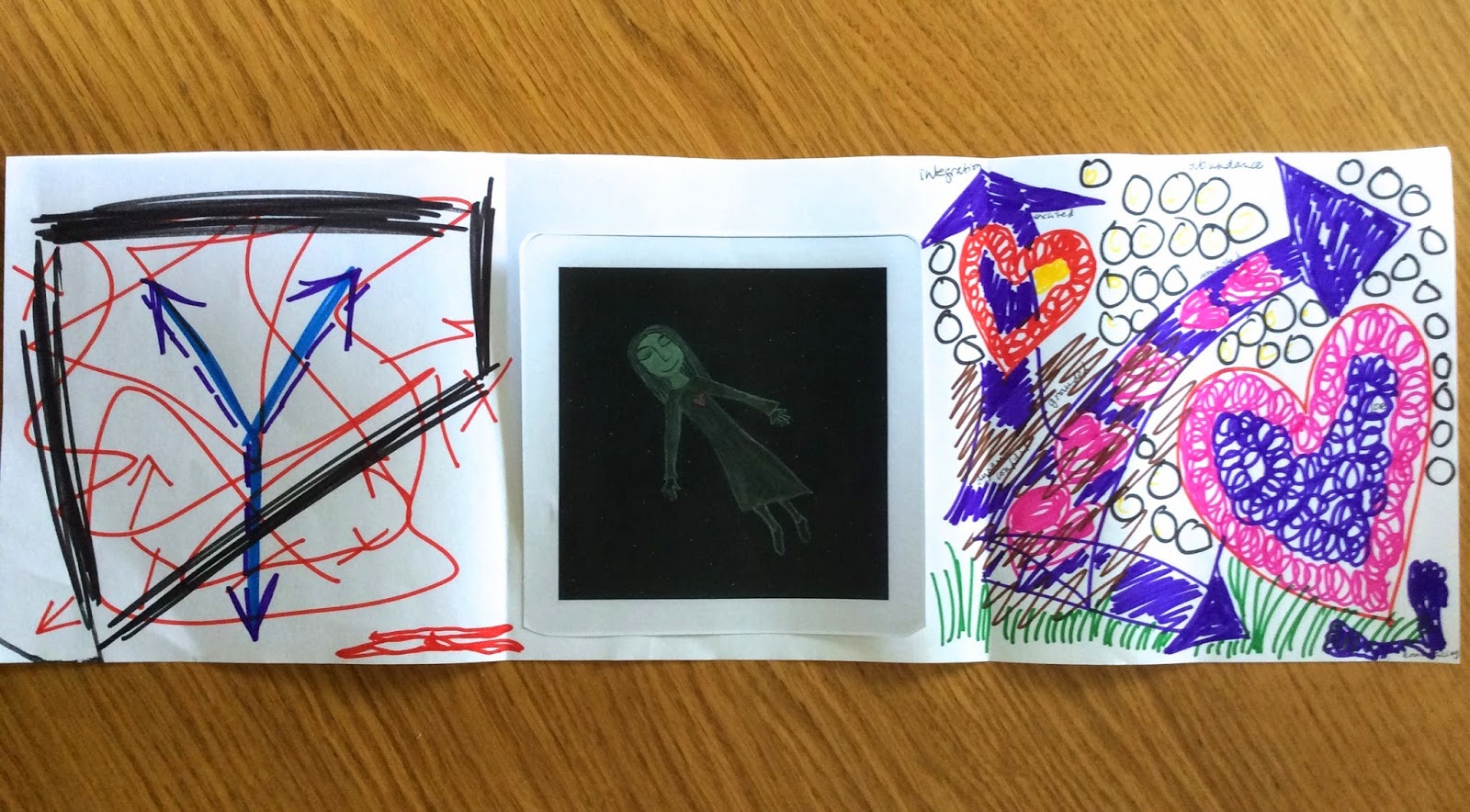
And by sharing a scribble I did at the WWNG (Working Women’s Network of Grenoble) seminar on “Knowing yourself and setting objectives”, last Saturday:


There I am, floating in dark hyperspace, between the past (on the left) and future (the right).

Before the day of the seminar participants had been asked to solicit views from people who had seen us in different situations of “flow”, or aliveness. It was no surprise to have confirmed that yes, I am alive and passionate when I’m in nature – either the garden or mountains, expressing myself freely in a (therapeutic) dance environment, sometimes doing shiatsu, teaching shiatsu, or when I am writing. Most recently it was my Japan trip that fired me up, filling me a sense of wonder and contentedness.

The invitation was to jump into our future vision and then map out a first step for getting there. But my “future” was entirely abstract, based on feelings, with nothing of any practical substance on which to base an initial target. So I’m afraid I didn’t even get off the starting block, and left the seminar no further forward with my “project”, or even with a sense of having a project. But I had the pleasure of connecting with several people in the very dynamic group, strengthening relationships and building new ones. It was a positive experience.

So all I need to do now is find a way or earning a living where I offer shiatsu retreats, teaching or organizing self-development courses in a mountain location where I can simultaneously write and illustrate with my own photos a book of mountain walks, and offer an exclusive B & B facility where I astound the world with my exquisite dishes. And from time to time someone will pay me to do an exotic trip of the style “middle-aged woman astounds herself and the world by…”, or to write about my experiences on the receiving end of therapy. And find a way of doing all of that within a relationship…

19 March 2015

last day of winter

It's official: tomorrow is the spring equinox. In the valley, crocuses, primroses and daffodils are insouciant of the risk of snow any time up to May.


After ignoring our grease balls all winter, the birds (including a "new" visitor - possibly a female blackcap) are finally attacking them with gusto. It's the time of year when everyone wants to shake off winter - and at the same time enjoy the last of the winter landscapes. Next month the unstoppable tide of spring will sweep up from the valley, and high-altitude crocus will push through the mottled slush and mud.

So today I took myself up to Chamrousse for my second, and probably last, day of down-hilling this season. The pistes were empty but the full-on sun meant the snow was pretty slushy. For this or other reasons I found it very hard to relax into a rhythm. Applying everything I know about the correct position and weight transfer I still felt awkward. I think I probably didn't want to move at all, or at least not that fast. Not ideal for skiing! And the pollution was the worst I've ever seen it - a brown smog extending beyond the top of the Chartreuse and Vercors massifs, so that the Mont Aiguille was barely visible.

Despite this, the mountains were glorious.


06 March 2015

too old for a summer job? - maybe not...

When I was in the UK in February I watched "A Cook Abroad" (you can view it on iplayer until 23 March) where Masterchef judge Monica Galleti travelled around the French Jura, being charmed by the local food created and served by small producers. "Getting back to the essentials" was a novelty, in comparison to her usual high-end restaurant dishes that had no connection with the raw ingredients and the people who farmed them. How much I share her appreciation – it's probably the best thing about living in France. In Vaulnaveys most of my food is grown or reared within 5km of our house.

At one point Monica was in a restaurant d'alpage (restaurant in a summer pasture) on the French –Swiss border, and my ears pricked up – surely she couldn't be far from where Juan lives, in Yverdon. As she talked with Norbert, passionate about his way of life, I googled around and found the auberge website: La Petite Echelle.

A few days later I got in touch with Norbert by email, to offer my services as a multi-tasking summer worker, hoping that my recent WWOOFing experience might add credibility to an otherwise weak-looking profile. Our email stream petered out but I wasn't deterred. I had planned to be in the area this weekend for a dance course and I hoped that showing up might make a good impression – the auberge is inaccessible by road in winter so it meant skiing 3km.


Walking inside the dark and slightly chaotic dining room I immediately spotted Norbert at a table, deep in what looked like a business conversation. I wondered what to do next. It was 11.30am and I didn't really have the appetite for the Roesti jambon saucisse salade. But I needed a way to keep me there until he was free. So I placed the order and the huge roesti went down a treat, the jambon de Mouthe and saucisse de morteau label rouge all they were cracked up to be (even though the potato in the roesti was a tad soggier than I've had it the Swiss side of the border).


Afterwards, Norbert spent some time talking with me. La Petite Echelle is more than just a place for a rustic meal in a forest clearing. As the website says, La restauration est en parfaite synchronisation avec l'agriculture, l'écologie, la culture et l'économie locale. And it's this that draws journalists from other parts of Europe, and the US, to learn Norbert's savoir-faire. I learned a curious fact about restaurants d'alpage: because of food and hygiene regulations they are only allowed to serve products that can’t "go off": bread, cheese, potatoes, salads.

There are a small number of solar panels but no other source of electricity – through choice. (While I was there the electricity board was on the phone, pushing to instal. Mais non. Candles are fine.) Run-off from the roofs is the only source of water for the one shower, for the cattle and for cooking. So no running water (this is true throughout the karst Jura), and no well. In dry years it can be tough.

Norbert is looking for people who can turn their hand to working in the kitchen, serving meals, looking after the heifers (who have to be rotated around six grazing areas), perhaps working in the veggie patch. "Yes, yes!" I cry.

And so I'm excited to say that I may well be spending some time at the Petite Echelle this summer. Norbert has suggested a couple of weeks, to start with, to see how we like each other. Between now and then I will decide if this is a fantasy or reality. Right now it seems a very attractive proposition.


26 February 2015

winter sun

I'm writing this in dripping Bradford on Avon. It's raining steadily and the catkins on the hazel I see from my bedroom window are blowing around in the wind. Iris, crocus, primrose, cyclamen, pulmonaria and snow drops are injecting colour into the awakening garden. As February draws to a close it feels as though we are turning a corner: spring is here.

So I do a reality check - and look at the weather in Grenoble. It's around zero and there is fresh snow in the resorts where the ski season will continue for another 2 months. Good and bad news. This year I was reluctant to embrace winter, returning from the Chilean summer in early January with no appetite for the outdoors. Most weekends have been low-key, a hibernation of eating and sleeping (and soul searching). But with two exceptions: a day walk to Lac Lauvitel, which Juan and I know well from summer walks but had never visited in winter. After a recent, but small, snowfall it was walkable in a way that might not usually have been possible in such a deep, avalanche-prone valley; the views of the lake ethereally beautiful.


A few weeks later I had a sublime day skiing at the Alpe du Grand Serre with Juan...


... followed a few days later by a night in an auberge near La Jarjatte, in the Haut Buëch valley with my cousin Cinda:


Again, the terrain was familiar from summer visits, when Juan and I have walked up to the surrounding cols. In winter the access roads are transformed into a cross-country skiing area; the meadows hidden beneath half a metre of snow. We were lucky - at this altitude snow can come and go.

Just for the record, I took this photo a month or so ago up at Laffrey lake, one dank Saturday when walking wasn't an option. In summer this is a favourite swimming spot:


So there have been some magical moments this winter. And maybe a few more before the snow recedes and the alpine summer arrives in all its glory.

chez les parents

Yes, there's been a long blog silence. For a mixture of reasons: a lack of inspiration after my travels; a desire for honesty - and at the same time not wanting to publicly share what is going on for me at the moment. But this morning I feel like writing.

I’ve been in the UK a week - one of my regular trips to see family, and this time coinciding with my sister Buff’s birthday and a massed celebratory gathering at her house near Shaftesbury. Phil has also been over, from Spain. And a rare, and long-anticipated musical event - the three of us playing the Beethoven Archduke trio together - takes place at Mum and Dad's, in Bradford on Avon.

It’s always a pleasure “coming home”, and seeing Mum and Dad. Their house is stuffed brimful with their, and my, history. I remember who I am. But it doesn’t come without its complications. I compare myself with my sisters, both more patient than me and, despite stringent efforts, I revert to type: the bossy, stroppy one. Mum and Dad's busy, cultured, community-led, activity-rich lives are in harsh contrast with mine. But a bit of it rubs off on me - it was indeed Mum’s inspiration for the sisters to play the Beethoven together. And the preparation for the event kickstarted me into playing my much-neglected piano. The day itself is a mixture of agony (I had deluded myself that I had any kind of grip on the piece, technically) and ecstasy (moments where I could relax and enjoy it). But we all want to play again. Maybe July…

On my own with Mum and Dad I try to be a Helpful Daughter. With Mum my great desire to reduce the piles and piles of accumulated paper detritus seems to have coincided with her own wish to declutter. For two days we wrestle the mounds of charity appeals, bank statements and mail-order catalogues (I am refraining from calling it “junk mail” as gardening items, bird food and thermal underwear are not junk, for Mum) into submission. Four large boxes are filled and taken to the tip. Along the way we wade through reams of family correspondence, funeral services, birthday cards. Obviously, none of this stuff can go - and it eats into our time. As does filing endless rogue bank statements that show up in every room of the house amid the copious charity bumph, and bagging up £19 of 1p and 2p coins that had been taking refuge in various jars and mugs.

I create an alphabetised spreadsheet of the 70 charities Mum supports, showing her which have direct debits. The idea is that she can note when she writes cheques to the others, and if they aren’t on the list they go straight into the recycling box.

The test comes the following morning when a couple of charity appeals arrive in the post.
"So, Mum, where will these go?”
She puts on her eager-to-please-little-girl face. “In the sitting room?”
Wrong answer. "Clue: it’s where they’ve always lived, Mum.”
Hopefully: “In the dining room?”
Correct.
But one of them isn’t on the spreadsheet. Quickly I chuck it onto the recycling pile, and there’s no objection. Phew.

Dad is another matter. Like Mum he wants to fight his way out of the paper jungle that is engulfing him. But he still thinks he has time to read the eight or more periodicals he subscribes to - even though many stay in their plastic wrappers from one month to the next. From “Prospect” to “Resurgence and Ecology”, “Walk”, “What the Doctors Don’t Tell You" and “Camping and Caravanning” they are all topics that interest him. How hard it must be to accept that there is simply too much information coming in. Once he can choose which magazines he really must read, and accepts that “There’s the occasional article that I’d like to look out and keep” is probably not a realistic strategy, and is blocking him from clearing out swathes of back issues, he’ll be in business.

But, again, all of this is a reflection of Dad's diverse range of interests. How wonderful to be so motivated - rather than shutting out and down, as I seem to be increasingly doing.

After two days of me churning up a storm, Mum and I are reeling. Time to go into the garden and look for trouble there. And we find it - in the greenhouse and surrounds… Back in hyper-organisation mode I round up a few hundred plastic flower pots. Impossible to throw any out, of course. But they are at least now stacked in neatly graded trays.

After lunch that day I think Mum had had enough. My, “Is there anything I can do?” is met by an invitation to play her violin, to get it back into shape. In other words: leave me in peace!

02 January 2015

Santa Cruz and Valparaiso

28 December 
Sunday is a day of rest and recreation in Chile. In Santiago many of the streets are closed to allow cyclists and roller bladers to cruise the traffic-free city centre. Unfortunately for us the Hertz office is located in a "closed" road. We piss off the cyclists (but how else can we get out of the cycle zone?!) and have a "snakes and ladders" start to our drive to Santa Cruz, not knowing which roads are passable. But all is well and we get onto the A5 south, driving through valleys where vineyards alternate with maize and other vegetables. Although we're on a motorway, there are stands selling watermelon, cherries and strawberries from stands along the hard shoulder. At the toll booths peasants sell a variety of street food.

We reach "Casa Pando", a km outside Santa Cruz, in one of Chile's best known valleys, the Colchagua, just before lunch. It's the one hotel we booked independently and by far the best value of the holiday. Run by Chilean Mariela and Spanish José, it's set in a beautiful garden with swimming pool. Mariela supplies us with information about eateries, wineries, and places of interest. Following her recommendation we have lunch in a stunning Italian restaurant on the edge of a vineyard. During the afternoon we visit local gaucho hat makers, Juan trying on every model before deciding not to buy; an ethnographic museum at Santa Cruz vineyard: and a fascinating craft museum in Lolol.

In the evening just one of Santa Cruz's restaurants is open, La Etiqueta Negra, packed with gringos.

29 December 
We follow Mariela's recommendation and visit Lapostolle vineyard - or at least the part of it used to create the Apalta brand, dating from 2005. Lapostolle is a French company (Relais Châteaux, the same owner as Sancerre), and proud of its imported French-oak barrels. We are surprised to hear the extent to which French and Spanish expertise seems to be used to check quality, across the industry. Although wine has been made in Chile for 500 years, the wine industry in Chile is very young; early 20th century is considered deeply rooted. 

There are many differences from European wine-making: the emphasis on single-grape blends (a wine can be named as a single-grape variety but include up to 15% of whatever other varieties the winemaker wants to include) - perhaps the influence of the American market; the grapes harvested at night because the cooler temperature gives a better flavour. Ninety-five per cent of Chilean wines are exported. And, because Lapostolle doesn't have a strong presence in Chile, their wines are cheaper in the US and Europe.

The most impressive aspect of the winery is the elegant, modern buildings. They were designed by museum-specialist architect Roberto Benavente. For earthquake-security and natural-chilling reasons, part of the building is underground. It required dynamiting of the granite, and a section of rock wall has been carefully retained, "framed" and lit almost as a work of art. At another point a Foucault pendulum has been incorporated into a three-storey spiral stairwell. (Juan has to suffer our guide's erroneous explanation - it is moved by the earth's movement, not by "a special kind of magnetism"!) When the lights are dimmed in the tasting room a twinkling "starry sky" appears.

The wine-tasting itself is underwhelming: just three, very young wines: Sauvignon Blanc, Merlot and Cabernet Sauvignon. It seems a bit mean. (And this vineyard gives nothing away - the four cabañas it rents out are done so at $1500 per night.) But it's a pleasant, informative experience, and the view from the terrace down the valley very lovely.

We skip lunch as Mariela's breakfast (fresh apricots and cherries, guacamole, scrambled egg, ham, cheese, warm bread and jam) has set us up for the day; and spend the afternoon in the Museo Colchagua. It is part of the same foundation that owns the Santa Cruz vineyard, and the craft museum. The range of exhibits is mind blowing. How can one man have gathered such huge numbers of pieces of pre-Columbian art, machinery, historical realia, vehicles...? He has such status that the collection of artifacts relating to the 2010 mining rescue has been entrusted to the foundation (for which The Independent voted it best museum). It is a compelling  display, including drill bits, the famous rescue capsule, letters, technical data, TV footage.

Back at Casa Pando José asks if we'd like to taste a wine, with two other couples also staying. You bet. We sit under the 85-year-old vine planted by Mariela's grandmother, and dripping with ripening grapes. José cracks open a Cab Sauv from a neighbouring valley. It is delicious - better than anything we've tasted that day. Mariela brings out pizza, cheese and jamon and I start to worry we won't have the appetite for the slap-up meal we've planned. José opens another bottle. I try to gauge whether Juan is eating as much as me. I think Yes. So I continue to nibble, and José opens yet another bottle. Now we can't go out - we've drunken far too much to drive. And still the wine flows. I am floating downstream in a fast-flowing current of Spanish and alcohol. 

Juan, meanwhile, has been able to ask the question he has been wanting to ask, about the aftermath of the Pinochet era. Mariela reveals that, because of the lack of closure, the wounds have not healed. We also learn how liberal the current government is: as a small business it is very easy to get a subsidy to expand, e.g. adding a swimming pool or hot tub, as they have done. Juan checks he has heard correctly; yes, a subsidy, not a loan. (We later hear how, in Valparaiso, small hotels have received around $12000 to commission street artists to create murals on the walls of their buildings.) But as for health or education - forget it.

José and Mariela answer our inevitable question about how they came to be there. It's a romantic story - they met on a tour during José's two-year world tour after his first wife's death. Now Mariela is the happiest she has ever been.

At near midnight we have collectively put away 7 bottles, and I admit I have consumed more than my fair share. We stumble back to our room, grateful for this precious evening and our hosts' incredible generosity.

30 December 
The last part of our Chilean odyssey is north to the coast, at Valparaiso. It's a longish drive as we have chosen the interior route over the Santiago motorway. Arriving in the city we helter skelter up and down the contorted, steeply cobbled streets in confusion. We arrive at our hotel just in time for the "welcome cocktail" (or at least those not recovering from the previous night's excesses), sitting on the top-floor terrace overlooking the downtown.

Valparaiso is like no other city. The psychedelically painted residential area sprawls across several different hills that plunge down to the sea. At their foot are the naval docklands and commercial zone. The city is so steep that half a dozen elevators dating from the early twentieth century connect the different levels. Our hotel, a stylish rebuild from two houses - 3 m doorways, airy staircases, original pieces of art on the walls - is typical of the constructions: you enter the building at one height on one side and exit two storeys lower the other side. 

We start to explore the city, quickly turned off by the chaotic, traffic-choked downtown (where we are warned by a shopkeeper to keep an eye on our valuables), retreating back up the hill to a café where we have a modest supper: packet soup and empanada. We will need to find a better place to see in the new year but are a bit freaked out to discover it would set us back more than €250 for the two of us to eat at our hotel. The search continues.

31 December 
Aside from its wild house colours, "Valpo" has achieved international status for its street art. In the morning we take a walking tour with an artist (cum sommelier, we later discover!). There are hundreds of murals in the city and he chooses a selection unaffected by the turf war" raging between factions of artists. I learn some new words: "tagging" (adding a signature), "flaring" (holding the spray can sideways to create a soft edge. Behind some images is a kind of visual rhyming Cockney slang. Other artists have established styles using e.g. pastels, or juxtaposition of realistic and figurative, or Surrealist. Art as protest seems to be a thing of the past: One Valpo boy, Inti, is now attached to a Paris art gallery. To buy his services for a full mural would cost the city $300,000. So, on his trips home, Inti just does the odd small piece. 

Inti is at the top of his game. But one story Al told us was very embarrassing: an English friend of the famous Banksy was commissioned to paint on a wall and, of all things, chose the national hero, Pablo Neruda. The result was so bad that the city council cancelled the inauguration ceremony.

Our guide, Al, works with a couple called "Un Kolor Distinto".  Under their guidance we create a mural on top of the existing one painted on a house next to the hotel.

In the afternoon Juan wanders some more, adding numerous photos to the ever-growing collection, and I do some writing. We have a quiet and enjoyable meal in a nearby hotel, adding layers as the wind picks up. Then see the new year in from our hotel terrace, watching a 40-minute firework display across the bay. Unforgettable.

1 January 
After a sleepless night while the whole of the city parties until well after we get up, we have what we think is our last breakfast in Chile. Events take an unfortunate turn, however. At Santiago airport, an accident during landing of another flight causes a 5-hour delay. We wait in our plane as the take-off time is put back and back, and then postponed until the next day. There is a long delay retrieving our luggage, and then huge confusion as 500 passengers mill around trying to get into a shambles of a minibus transfer to a downtown hotel. Having spent the best part of the day at the airport we find ourselves having supper at half past midnight. A bad start to the year but at least this blog is now up to date! Over and out for now.

31 December 2014

San Pedro de Atacama

23 December 
A day of travelling, and hanging around in airports. At Santiago airport, in the middle of the departures hall, a group of children are drilled through Spanish traditional, and Chilean festive music, accompanied by a small band. Most take a turn at singing solo, giving their all under the exuberant encouragement of their conductor. One chubby 12-year-old was fit to burst as she tried to do the right thing, then visibly relieved when her turn was over. My heart went out to her, memories of how I saw myself at that age flooding in. I'm glad to feel just an inkling Christmassy.

Flying over dry brown mountains and salt lakes we arrive late pm at Calama airport, 1000 or so km north of Santiago and the "portal" for the Atacama desert. The rental vehicle is familiar: a red Mitsubishi pick-up, its wheels securely padlocked, even in the airport carpark. According to the Hertz rep there is a very high theft rate: vehicles are stolen and then driven across the Bolivian border for resale, with the connivance of the frontier guards. We drive past Calama (annual precipitation 5 mm), a copper-mining settlement where every house hides behind locked railings, petrol station shops protected in a similar way. Distant hills - the altiplano - gradually come into focus. Just before San Pedro we pass through the edge of the Valle de la Luna reserve. Its contorted crags, and ridges of tilted sedimentary rock, are spectacular in the evening sun.

Entering San Pedro, a small, laid-back oasis village sitting at 2400 m, between the altiplano and desert, we go a few loops on the narrow dirt roads before finding our accommodation, Casa Don Tomas. It's a middle-to-up-market place, half a km from the village centre, and slightly controversial booking - a far cry from the backpacking places I prefer. Don Tomas caters for those who speak no Spanish, prefer guided tours to autonomy, value pool relaxation over running around the altiplano landscapes, and are not inhibited by budget. On the plus side we are very comfortable, a short walk from the centre, have access to a computer (great for marital harmony) and - important for Juan - a clean, dust-free environment. (I admit I also like being able to get and stay clean after returning from our daily sorties with dust up my nose, throat dry and hair stiff with wind and sun.)

San Pedro has been an important settlement since pre-Hispanic times, a major stop on the trading route connecting the llama herders with the coastal fishing communities. It was first settled by Pedro de Valdivia in 1540, and his house still stands in the atmospheric village square. A decorated (artificial, of course) Christmas tree is positioned next to a large crib scene, the only indication in the village that we are in the festive period. The dusty streets are lined with single-storey adobe "artisanal" shops selling an identical range of (perhaps) alpaca wool scarves, colourful throws (probably from Bolivia or Peru), and lapiz/copper jewelry. In the evening the streets and numerous restaurants and bars fill with throngs of the young-ish; Andine flute music floats from cafés - or live music from restaurant terraces.

The village is now a tourist hotspot, a base for day or longer trips to the geological marvels in the surrounding Atacama and altiplano. This first evening we just have time for a brief stroll before having supper.

24 December 
We take our cue from the many agents advertising itineraries and visit the Salar de Atacama, a huge salt lake where three species of flamingo feed, their "S"-shaped necks making extraordinary reflections. Plovers and sandpipers are busy in the foreground. It is a wonderful moment, even if the restrictive walkway prevents us from getting as close as we would like.

We drive on up to the altiplano via the hamlet of Socaire. We are on a very well-established route, jumping out and snapping the scene alongside dozens of other tourists. Around the village are pockets of green - small fields, the occasional tree. It's hard to imagine how run-off from the surrounding volcanic hills would create enough water to sustain the precarious agriculture through the summer drought. But, right next to the church, is a small plot of healthy-looking broad beans. We drive on, picking up a peasant woman walking in the midday heat on crutches, apparently on her way to water her crops. At the point where we drop her the desert looks relentlessly barren. How can she scratch a living from this brutal landscape?

With little experience of what a pick-up can cope with, and scanty maps, deciding where to drive is not straightforward. But Juan is getting skilled at riding the corrugations, and I am getting better at staying calm as we skid around. As we climb, the tussocks of grass - classic pampa - are golden, the sky blue blue blue. We enter the Reserva Nacional Los Flamencos and, from the registration car park, have our first glimpses of vicuña, their golden fur almost camouflaging them.  

Descending the track, Laguna Miscanti appears indigo blue; the surrounding volcanic hills shades of rust; the sky intense blue. We are at around 4200 m and there's a strong wind Although it's summer, we are wearing windbreaks. As at the Salar, access is strictly controlled: we have to stay on a short track that avoids going to the shore of the lake so as to leave the nesting giant coots in peace. Physical exertion is to be avoided: the high altitude is giving me a dull headache, and I notice a pain in my chest when I walk at "normal" speed up the path.

We continue in our vehicle to Laguna Miñiques and watch a group of vicuñas feeding by the lake. A park ranger - presumably on the payroll to ensure drivers adhere to the official road - dozes in the sun. Juan manages to sneak off piste for a photo of a "new" mat-forming plant.

Back at San Pedro it's Christmas Eve. We return to our restaurant from the previous evening for their "Christmas meal" - no different in essence from the usual 3-course but an opportunity to double the price! Beetroot soup, steak, cake; and the ubiquitous Concha y Toro Casillero del Diablo cab sauv. 

25 December 
We are up at an unholy hour on the holy day, 3.45am, in order to link up with a group tour going out to the geyser, El Tatio. This because I have convinced Juan that the 200 km return drive on dirt roads would be very tiring to do on our own, especially on a road we didn't know, at night; our agent having recommended avoiding this stretch of road; and Lonely Planet describing the journey as an "ordeal". In fact the road is no problem. And we both find the constraints of the tour difficult - unable to stop and take photos.

We arrive at the 4300 m volcano crater at 6.30 am, along with a couple of dozen other vehicles. Across an area of a couple of square km 80 geysers (8% of the world's total) perform in the sub-zero dawn. Some spout upward in the classic geyser way; others appear as clouds of steam, or "fumaroles". Nearby is pool of hot water where we are invited to soak. Much as I like the idea, stripping off in the chilly temperature, and immersing myself in water that is only between 15 and 25 degrees, is resistible - especially as our guide warns us not to exceed 20 minutes in the (sulphurically) toxic water.

On our way back to San Pedro we stop at Machuca, originally a llama-herder settlement, lost in a fold of the altiplano hills, now the obligatory stop-off point for the tour buses. The population has declined to just four permanent villagers - there's no school or shop. Just after having oohed and ahed on seeing our first llamas (domestic, as all llamas are) we are confronted by an Indian villager selling them as kebabs. One of our group goes for it - but it's still too early in the day for me.

Surprisingly - it's Christmas Day - the little blue and white church is padlocked. Passing an adobe thatched cottage I hear excitement as presents are unwrapped and listen for a moment, celebrating Christmas vicariously.

Back at San Pedro Juan pays a price for the heat, altitude and frustrating ride: a humongous migraine. So, late afternoon I drive to Valle de la Luna on my own. The sand, salt and rock formations shaped by the wind have given it the lunar quality of its name. Along with hundreds of others I digitally gobble the views. On this memorable day I see the sun rise and set. 

26 December 
We make up our own tour, taking a road towards Bolivia and the Reserva Nacional de Fauna Andina Eduardo Avaron. At the border the barrier is down and as we walk in the chill air to the adjacent hut we assume that we'll need to show our passports. But we aren't expecting to be turned back because of not having obtained the necessary exit and re-entry paperwork. In the office a photo of Bolivia's Evo Morales stares down at us; two little girls, wrapped in blankets, watch us dully. What could be their story?

After keeping us in suspense the immigration officer says that, "exceptionally", he can give us a permit to visit our destination, Laguna Verde. Juan is anxious that we'll have difficulty re-entering Chile if he is in fact breaking a rule, and someone else on duty when we return. The complications that would cause us don't bear thinking about. But three round-faced Indian officials reassure us and we drive on.

The landscape is starkly beautiful: reddish volcanic hills, pale blue-white Laguna Blanco followed by Laguna Verde, Volcán Licancabur dramatically reflected. No vegetation. At the edge of Laguna Verde we walk on crunchy white - and have to touch it to discover that it's ice, on top of salt. Alone for a moment there is total silence. Surrounded by peaks and lakes, with distant views of flamingos, it's a magical moment. We gaze at the endless wilderness. "I feel sorry for the conquistadors", Juan observes.

Bolivia's poor economic status is seen in the absence of park-rule enforcement: 4WDs have carved out myriad paths around the lakes. Within an hour of our arrival dozens of jeeps arrive from San Pedro taking tourists on multi-day trips. 

We drive back into Chile and then on the road to Argentina, to stop at an un-named lagoon that appears as a smudge of green on our map. We strike gold: no one is there, we can walk up close to vicuña and flamingos, and the light is perfect. We pass a blissful hour there before returning to San Pedro, and revisiting Valle de la Luna.

27 December 
A day of catching up with email, a quick trip out of the village to snap some shots of the cacti we hadn't been able to photograph during the group tour, and a flight back to Santiago. There's a lot of hanging around before we arrive at our hotel. Then a late meal in the hotel where we taste our first truly Chilean dish: pastel de choclo, a kind of shepherd's pie made with puréed sweet corn and a mixture of chicken, beef and hard-boiled egg, with crunch sugar over the top. We are almost at the end of our holiday but have a couple more places on our itinerary before the trip is over: Santa Cruz and the Colchagua valley, centre of the wine industry, and Valparaiso.